

Szabolcs Szolnoki | Insomnia
solo show
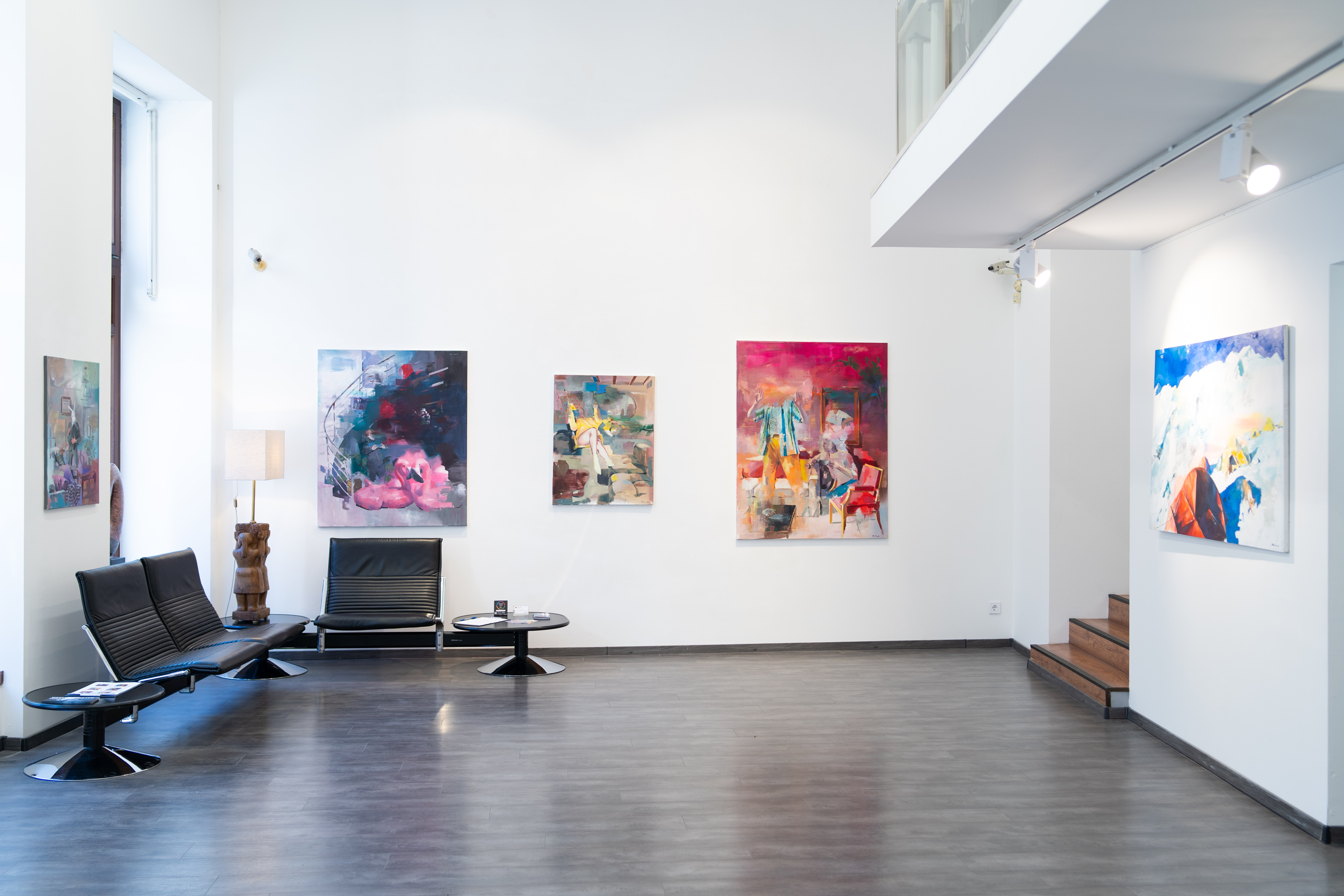
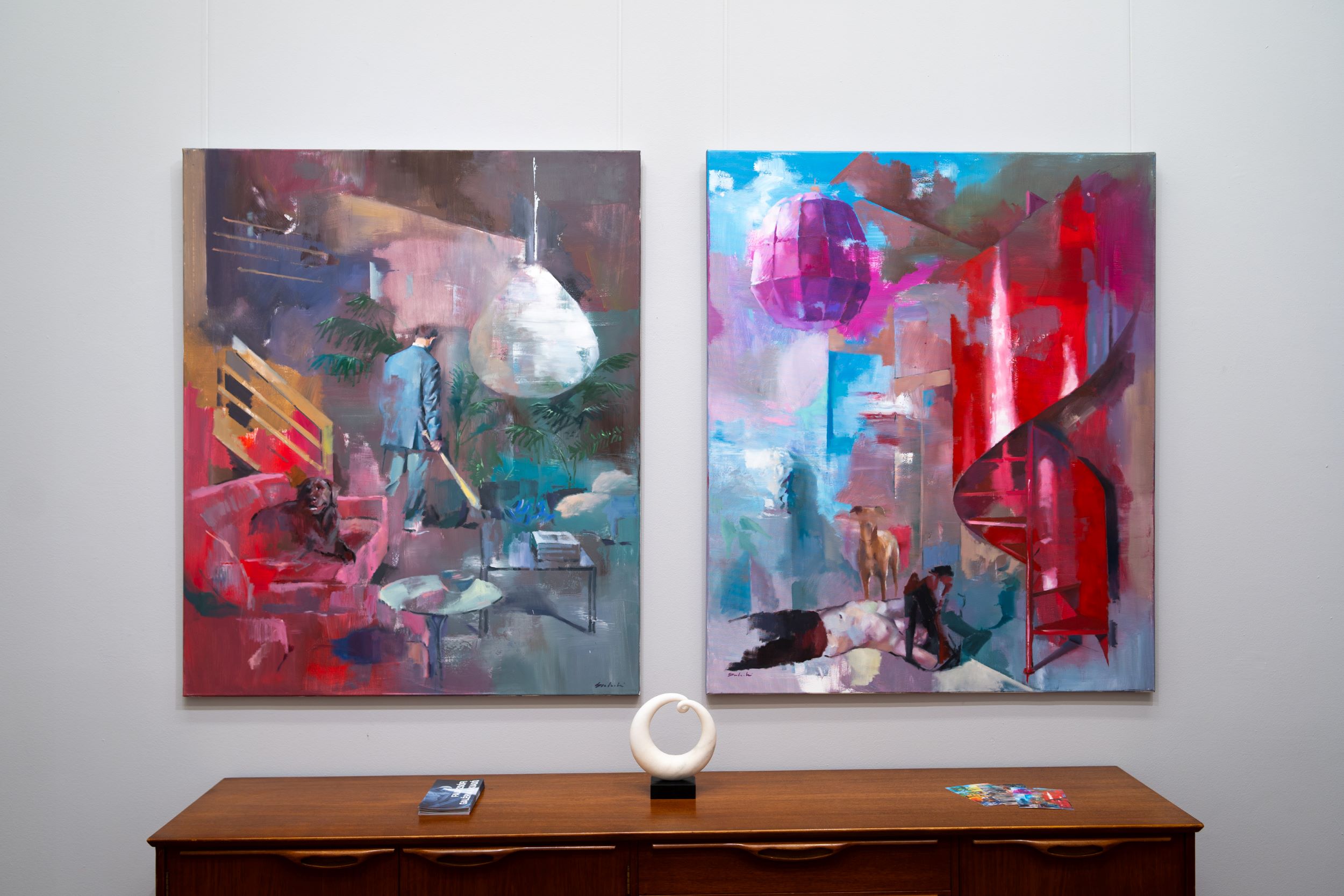
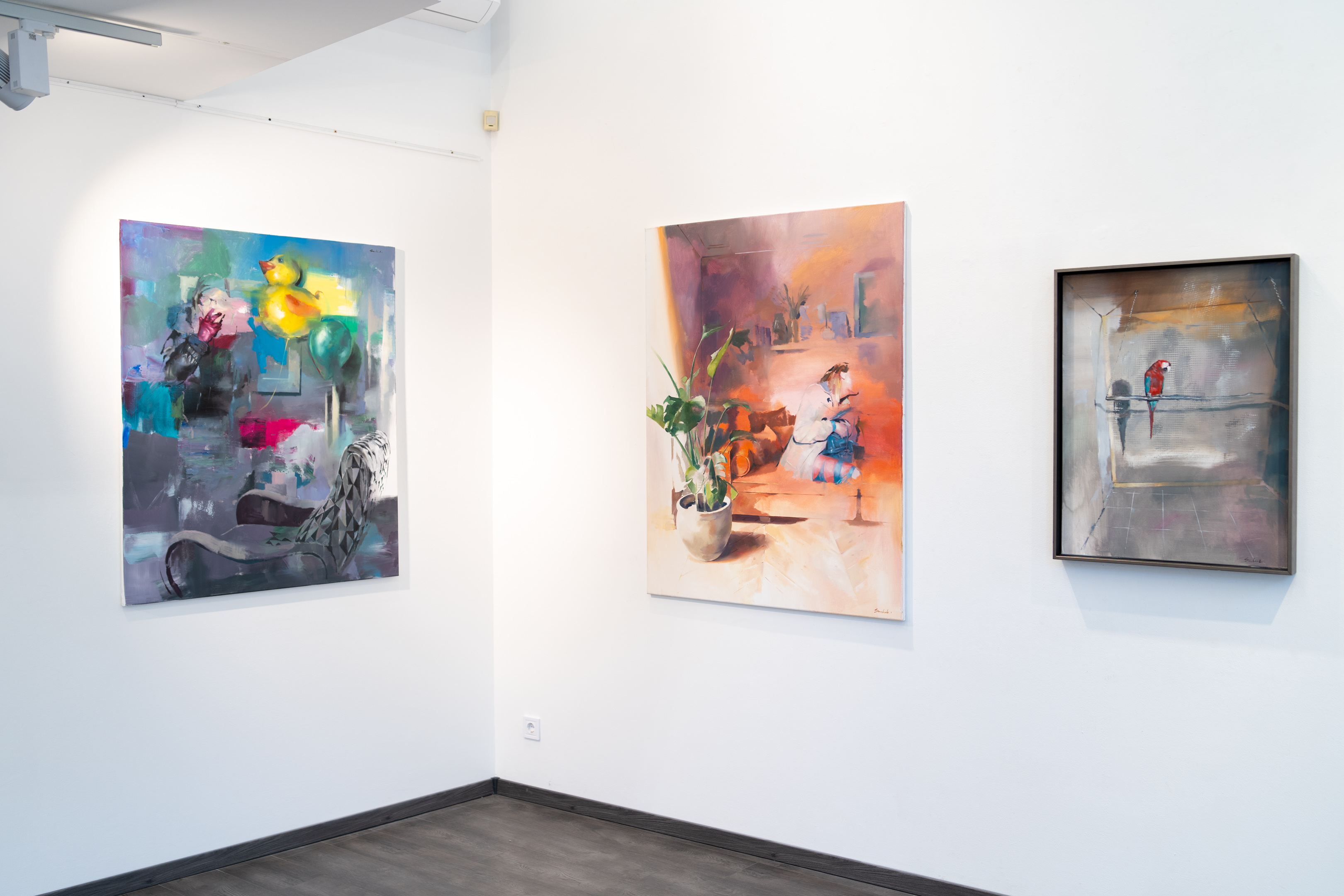
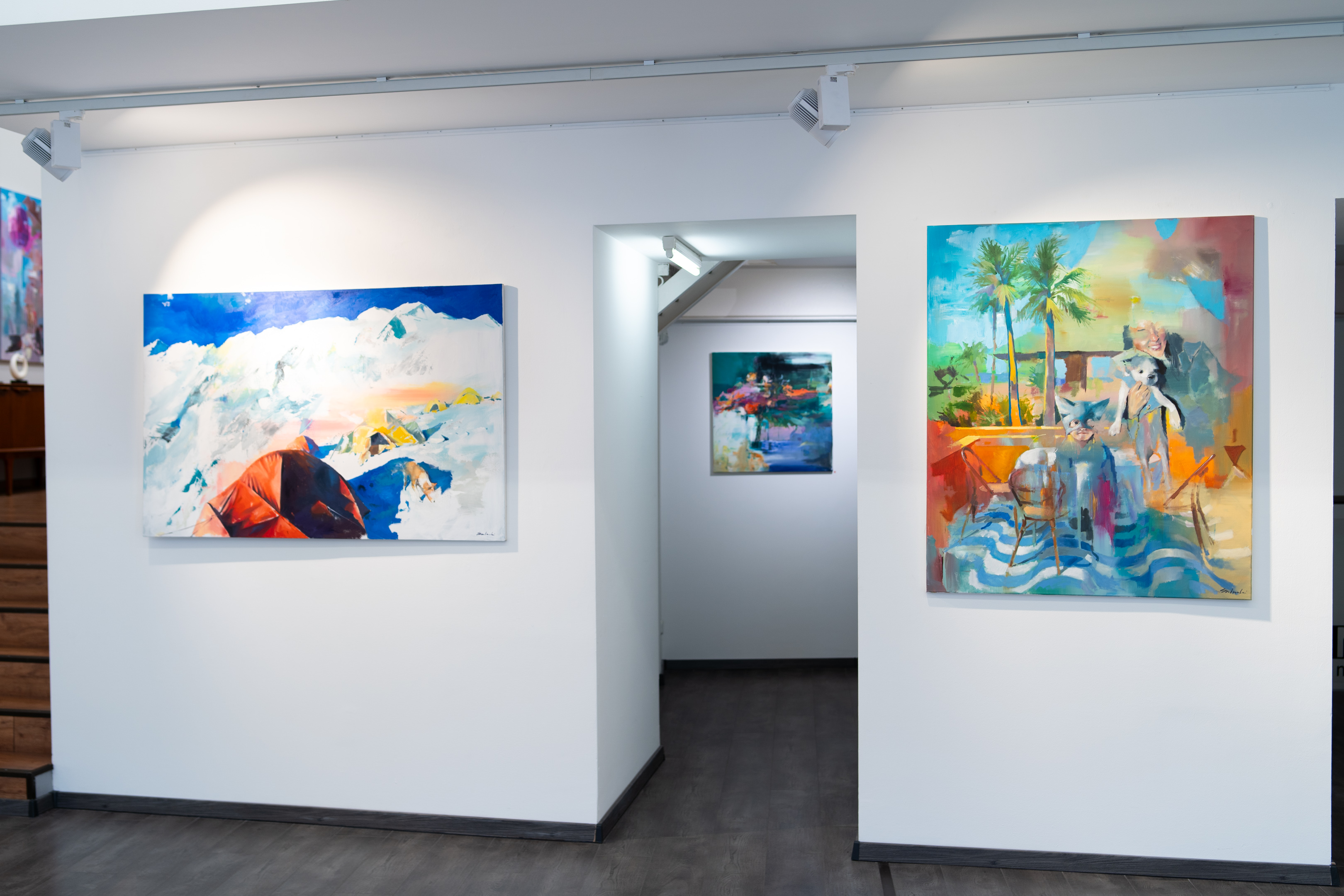
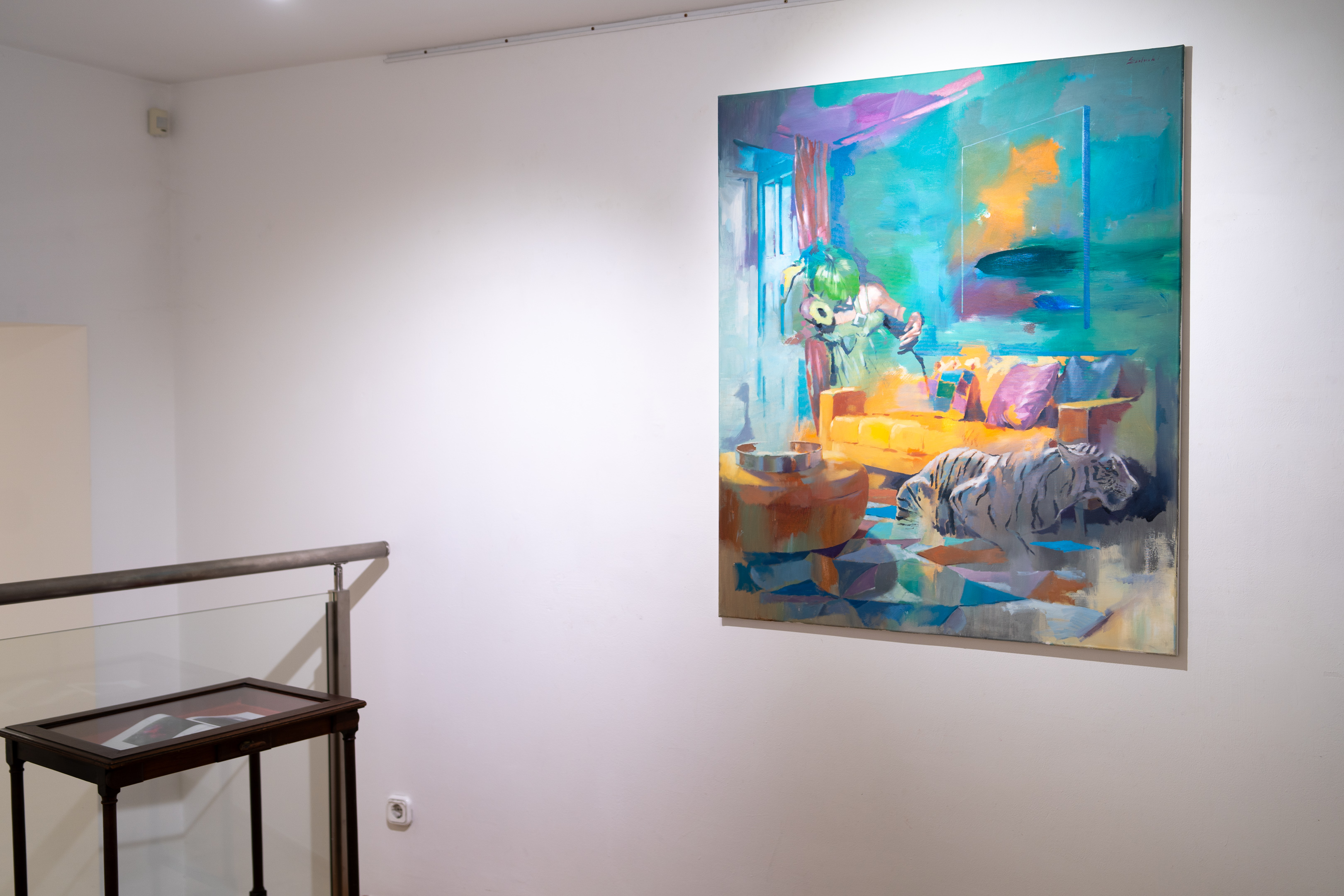
In his new works, Szolnoki continues to explore the visual language familiar from his earlier paintings, leading viewers into the strange psychological states of sleeplessness and into a world suspended between wakefulness and dreams. Figures, people, animals, plants, and objects merge into their surroundings in a mist-like, almost ethereal way, while blurred details keep the viewer on the edge between reality and imagination, figurative and abstract, recognition and uncertainty. The paintings have a visionary quality: some details appear sharply, while others dissolve into a floating, diffuse atmosphere, with contours that almost vanish into the background. When it is not the shifting, liminal spaces themselves, it is the slightly alien, out-of-place presence of the figures that unsettles the viewer and prevents a fixed perspective. As with Szolnoki’s earlier works, the associative pieces in Insomnia do not convey a single narrative. Instead, the viewer’s own memories, experiences, and associations actively shape and complete the scenes hinted at in the paintings.
Szolnoki’s art evokes the unpredictable nature of cyanotypes: it outlines forms with clarity while leaving space for chance and incompleteness. His paintings invite us into a glimpse of personal dreams -fragmented yet vividly immersive worlds that feel at once familiar and strangely otherworldly. (Gábor Martos)
The Briefcase-Carrying Rabbit – or, the Upper Middle Class Goes to Heaven
“Liberty means responsibility. That is why most men dread it.” (G. B. Shaw)
It is rare in Hungary today to find a painter who is at once critical and ironic, and who simultaneously takes on the fundamental questions of painting itself—representation, color, composition—as central themes of his work. Szabolcs Szolnoki is one of those who have chosen this mode of artistic expression. In other words, one form of freedom.
He is a par excellence painter: he draws excellently, with a light hand—and I can bear witness to this—and with great speed he commits his fantastic ideas to canvas. Fantastic, because what he creates is at once a relaxed interior, a figure, and a grotesque, striking, surprising montage. Szolnoki’s virtuosity is also a sharp weapon. He uses his superb drawing skills and sense of color to present the pictorial narratives of his works. Pictorial narratives—or we might even call them modern fables, moral tales.
Among his antecedents we can find not only Brueghel, Doré, and Csernus—through him Bernáth Aurél—but also Aesop, Gáspár Heltai, and La Fontaine. The latter three masters were outstanding creators of literary fables. And Szolnoki’s paintings, to me, are illustrations of such instructive tales. Yet these tales—though we may trace their roots back to the aforementioned authors—are written by Szolnoki himself. With a brush, onto canvas.
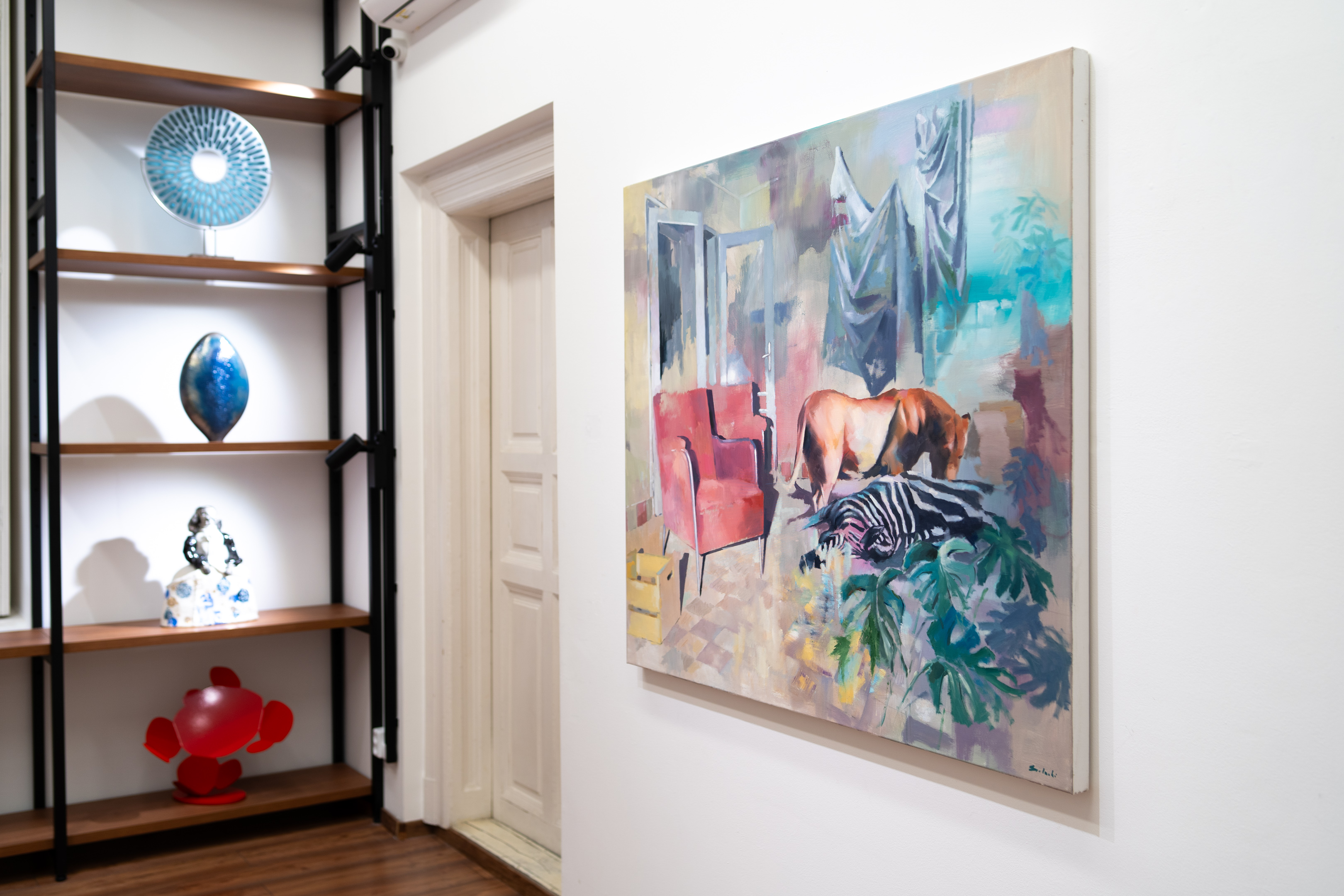
Let us take a look. There is, right away, the briefcase-carrying rabbit mentioned in the exhibition title. The timid yet scheming bureaucrat of our age, who with agility and caution has put together an excellent apartment. Now he looks us boldly in the eye. He is no longer afraid. Or the announcer with a doorbell for a head, who dutifully reads out anything once the device replacing his head is pressed. The lioness producing a zebra rug from a living zebra amid modern furniture, the animated tiger skin—all are frivolous representations of everyday luxury. And the blurred—headless—figures may be the impossible portraits of above-average average people.
Of course, there are gentler tales as well: the unicorn girl, the pink rubber flamingo couple taking their place in an elegant milieu.
Szolnoki creates a cheerful, vibrant, contemporary color world, because in this way he can make the acceptance of his characters even more extreme. Their lives belong to the world of the high middle class. Their roles, their existence, their possible parasitic nature dissolve into mainstream acceptability.
The painting of Szabolnoki Szabolcs is a subtle yet critical presentation of this contemporary world. He is our contemporary, for in his painting one can discern the influence of the Cluj school (Genie, Șerban Savu) or even the London school (Julie Saville, Paula Rego). His distinctive technique of omission makes his works even more special, as we sometimes perceive the paintings—often leaving visible the white of the primed canvas—as sketches, at other times as fragments. His painterly language is at once elegant and mysterious. The painterly solution of inserting nearly photorealistic figure elements among almost abstract colored patches and planar plant motifs is also masterful. A single colored shadow, an elegantly placed streak of light, renders the figures of the paintings plastic and tangible.
Strangely enough, even the thematic frivolity of Rococo appears in a new guise in Szolnoki Szabolcs’s works. Just look at the image of the woman swinging rather erotically in the room. The precedent may be familiar. Fragonard’s The Swing (original title: The Happy Accidents of the Swing), a painting from 1767, depicts a lady being swung while her lover watches from below, peering under her skirt. From Szolnoki’s picture the voyeur is missing—perhaps that role is ours. Just as, drawn by the attraction of all his intoxicatingly colorful paintings—like an insect to the light—we move closer and closer, and by the time we almost immerse ourselves, we are forced to notice something, something strange. Something out of place.
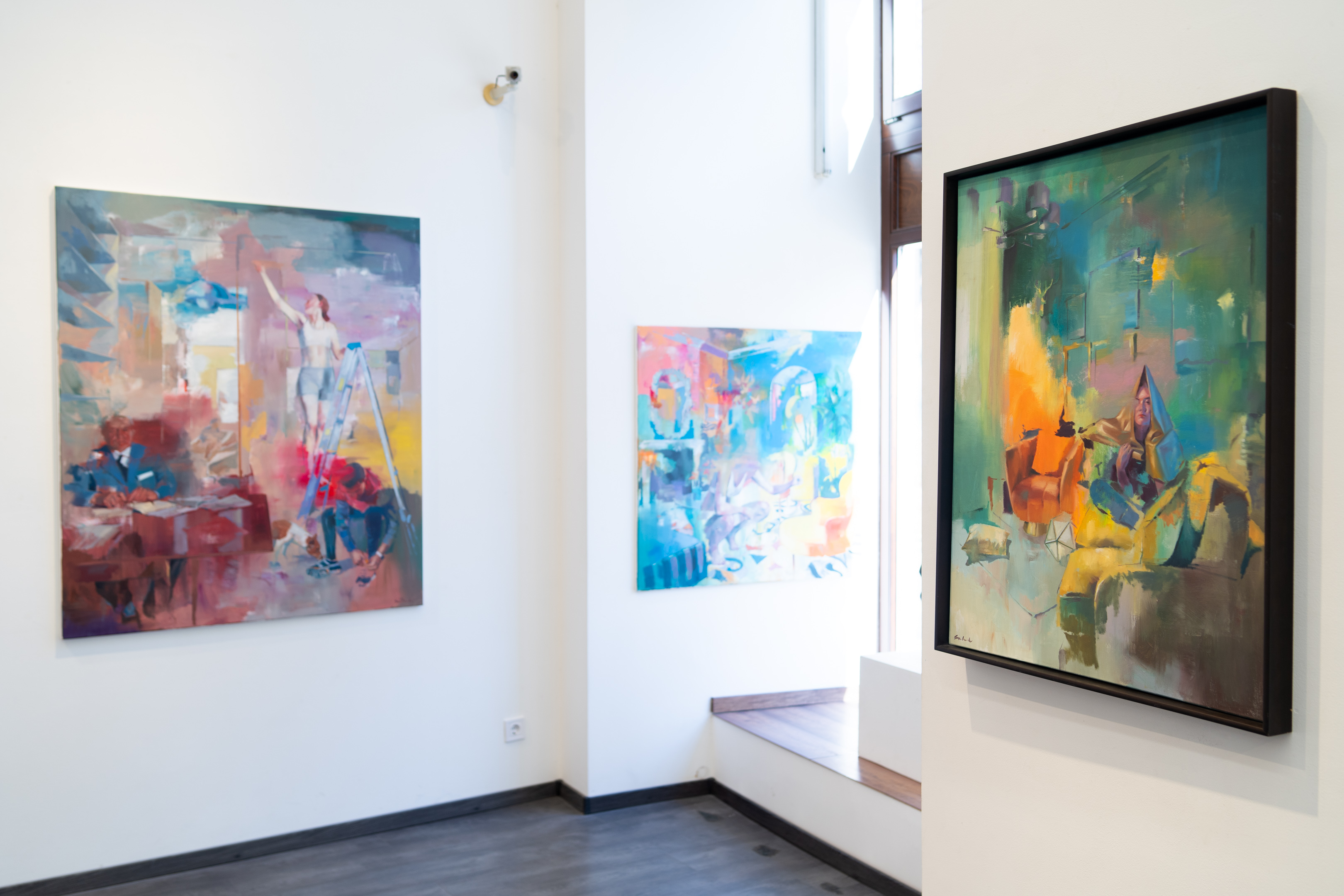
What does the suited gentleman with a baseball bat want in the interior? Why does the bureaucrat sit at the desk while a cheerful lady paints the room from a ladder? What is the mischievous balloon doing in the room? And the smoking gentleman, who is barely visible?
Mysteries, questions to be deciphered for voyeurs—and of course, once the solution is found, the fable, the moral tale itself becomes understandable.
Dear art collectors eager to buy: anyone who wants to purchase a painting by Szolnoki Szabolcs should think it through carefully; along with it, they are buying a life-mystery, a thorny question as well. Two in one. Already worth it.
// Opening speech by Sinkó István